Heat Pump CoP Evaluation — Mitsubishi Hyper Heat System
A real-world coefficient of performance analysis of a residential heat pump system, using Home Assistant data logging and engineering-grade measurement methodology.
My System
The system is built around a Mitsubishi MXZ-SM48 Hyper Heat outdoor unit rated at 54,000 BTU/hr, connected to a branch box inside the house. The indoor side consists of:
- A ducted system with a 36,000 BTU/h Intelli-HEAT coil
- A 12,000 BTU mini-split head
- A Lennox gas furnace with blower as backup (1,000–1,250 CFM)
The house is ~3,400 sq ft. The ducted system is designed to heat ~2,000 sq ft. A 12K mini-split head heats the basement, and a separate 15K system handles an upstairs addition (which runs great independently).
Theory of Measuring CoP
CoP measurement follows a methodology similar to AC unit SEER testing, drawing on:
The core formula:
CoP = System Output Power / System Input Power

System Output Power  = (T_out - T_in) × CFM × 1.08
System Input Power   = AC Power (W) × 3.412
Sensors measure:
- Input air temp — at the ducted system air intake, before the furnace filter
- Output air temp — above the Intelli-HEAT coil
- AC power — electrical consumption of the system
- Outside temp — recorded for reference only, not used in CoP calculation
The CFM Problem
The weakest variable in the measurement is airflow (CFM). Professional SEER testing uses specialized equipment that temporarily replaces the air filter — outside the budget for continuous home monitoring. Four independent methods were used to estimate CFM:
- Assume the indoor coil runs at max 36K BTU, then back-calculate airflow from temperature delta
- Run the gas furnace at max, use its spec'd performance and temperature delta to calculate airflow
- Run the gas furnace, measure gas consumed (reduced 20% for furnace efficiency), calculate airflow from temperature delta
- Use the Lennox spec sheet value of 1,250 CFM
All four methods returned values between 1,000 and 1,200 CFM. Current data uses 1,250 CFM, which produces the highest CoP estimate. Finding someone with proper airflow measurement equipment remains an open item.
The Measurement System
All sensors feed into a Home Assistant data logging instance, enabling:
- Real-time plotting of temperature delta and power consumption
- Historical trend analysis
- Calculation of coil heat output (CoP numerator) and effective electrical heat output (denominator)
- Monthly average CoP tracking
The workflow is to observe the system stabilize (typically 10+ minutes), then record outside temperature and CoP at that stable point. Spikes and drops before stabilization are included in the monthly average, which is a known limitation.
Data
Typical 4-hour window on a 20°F day — CoP bouncing then settling just before the unit cycles off:
(Chart: Home Assistant live plot — CoP and temperature delta over time)
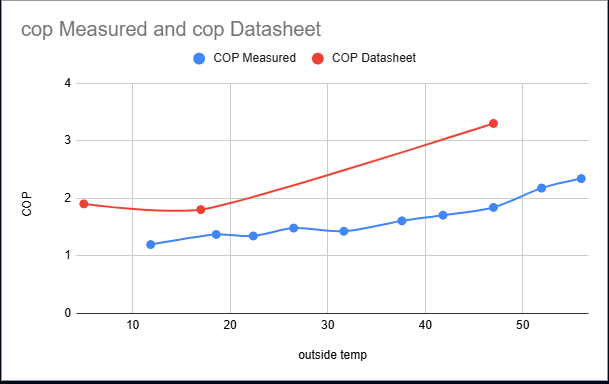
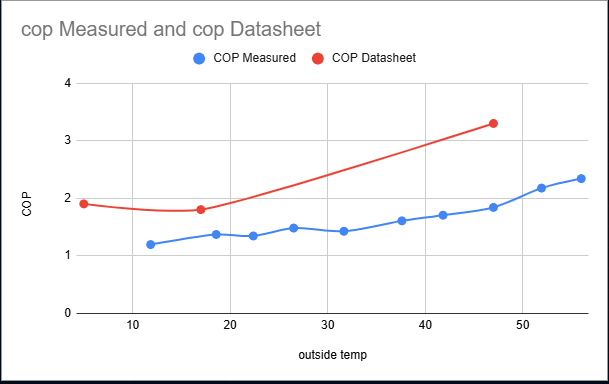
CoP as a function of outside temperature:
Analysis & Observations
Originally calculated with 1,000 CFM, which made system performance look ~20% worse. Switching to 1,250 CFM revealed:
- Performance looks reasonable at low outside temperatures
- ~30% below spec at higher outside temps (~47°F)
At 47°F the system should produce a CoP of 3.3 — measured value is ~2.3.
The hypothesis for this discrepancy: at low temperatures the compressor is already working hard, masking any additional loss. At higher temperatures, the system should ease up — but it doesn't. This suggests poor refrigerant flow in the lines is causing the compressor to continue working harder than it should, and this effect is harder to detect at low outside temps where the compressor baseline is already high.
The ducted system also has 16 vents but only 2 intakes (~10in × 32in each). Additional intake area would likely improve performance.
Measurement methodology references: NREL fy11osti/49881 · Fargo Heating & Cooling